Leadership That Lasts
Aligning Values, Behavior, and Outcomes in Education

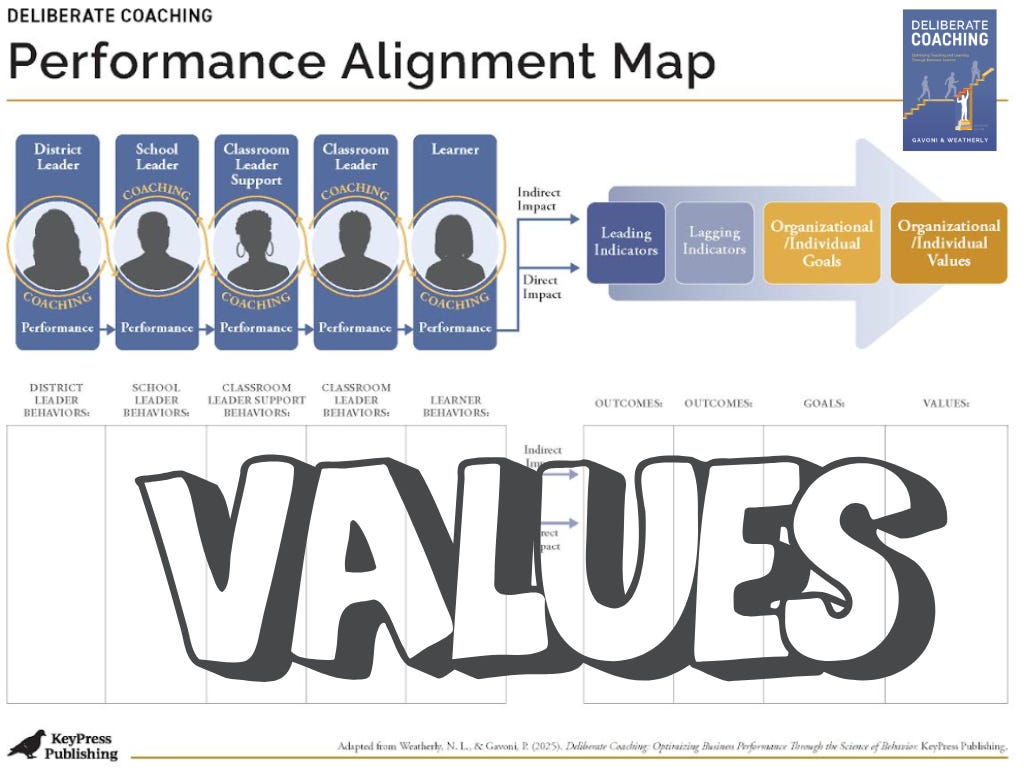
Values-Based Alignment: Turning What We Care About into What We Do
This is a longer piece written for leaders who want to understand why values often fail to show up in daily practice—and how behavior science helps close that gap. If you’ve ever felt that good intentions weren’t translating into sustainable results, this essay is for you.
Values are deeply embedded in education. They appear in mission statements, staff meetings, student handbooks, and classroom posters. Words like respect, responsibility, and integrity are familiar, widely accepted, and rarely challenged. Most educators genuinely believe in them.
The challenge is not whether values exist, but whether they actively guide behavior. Values matter when they are translated into daily action—when leaders clarify what those values look like in practice and reinforce the behaviors that bring them to life.
This is where leadership grounded in behavior science becomes essential. Organizational Behavior Management (OBM) focuses on designing systems where what we say we value is reflected in what people actually do. This is important because all results in any organization are dependnet on behavior. When behavior is aligned with values and results, meaningful outcomes are sustained over time. I’ve worked in schools where the local and state union reps called the turnaround a “miracle.” My response: It’s not a miracle, it’s behavior science. The work is not about slogans, motivation campaigns, or miracles. It is about alignment.
Understanding What Actually Motivates People in Schools
To build alignment, leaders must first understand what drives behavior across roles. Defining values behaviorally matters for a simple reason: behavior only continues when it is reinforced. That reinforcement does not come from mission statements or recognition programs alone. It comes from the outcomes people experience as a result of their behavior.
When leaders hear the word reinforcement, many immediately think of pats on the back, “good job” comments, awards, stickers, tokens, or gift cards. Those tools are not wrong, and they are not useless. They serve an important purpose by signaling appreciation and acknowledging effort. People want to know their work has been noticed, and recognition can play a meaningful role in that process.
What recognition programs typically do not do on their own is sustain behavior over time. Most educators are not showing up every day, planning lessons, managing classrooms, and supporting students because of the possibility of a gas card at the next staff meeting. Recognition acknowledges effort, but it is rarely the reason the effort continues.
What sustains behavior are outcomes. Teachers persist because they see students engaged, learning, and growing. Students continue reading because they enjoy it and feel competent. School leaders stay visible and involved because they value being connected to classrooms and supporting teachers as they develop. In each case, the behavior maintains itself because it reliably produces results that matter to the person engaging in it.
That word valued is doing important work here. Reinforcement is strongest when behavior produces outcomes aligned with what matters to the individual. Whether we are talking about students or adults, most people want two things: to feel valued and to produce valued results. Effective systems are deliberately designed to make those outcomes more likely. They identify value-added behavior and ensure that the natural results of that behavior are experienced often enough to sustain it. Over time, the work maintains itself—not because of incentives or supervision, but because the behavior consistently leads to outcomes people care about.
This is also where many well-intended recognition systems fall short. Programs like Teacher of the Month are often designed as competitive recognition structures. One person wins, many do not, and over time the system creates more losers than winners. The issue is not appreciation; it is design. When recognition is comparative rather than criteria-based, it fails to reinforce growth for most of the staff.
If leaders choose to use recognition programs, they are far more effective when they are aligned to clear behavioral criteria tied to each educator’s current level of performance and areas for growth. In that kind of system, many teachers can succeed because success is defined by progress toward meaningful, attainable goals rather than by outperforming peers. Recognition then supports improvement instead of unintentionally discouraging it.
Once reinforcement is understood this way, it becomes easier to see why different roles in a school system are motivated by different outcomes. Every person is shaped by what they care about and what their environment reinforces. Teachers are often motivated by student growth, professional autonomy, and the sense that their work makes a difference. Principals tend to value team cohesion, steady improvement, and trust from staff. District leaders are typically reinforced by system-wide outcomes, stability, and long-term viability.
Systems gain traction when they connect to those motivations. When initiatives align with what people already care about, engagement follows naturally. When they do not, even well-intended efforts are experienced as additional demands rather than meaningful support.
This is why values matter. True values have a motivating effect. They give people a reason to act, persist, and invest effort. That motivation becomes reliable when values are translated into behavior people can see, practice, and experience as effective.
Making Values Usable in Real Settings
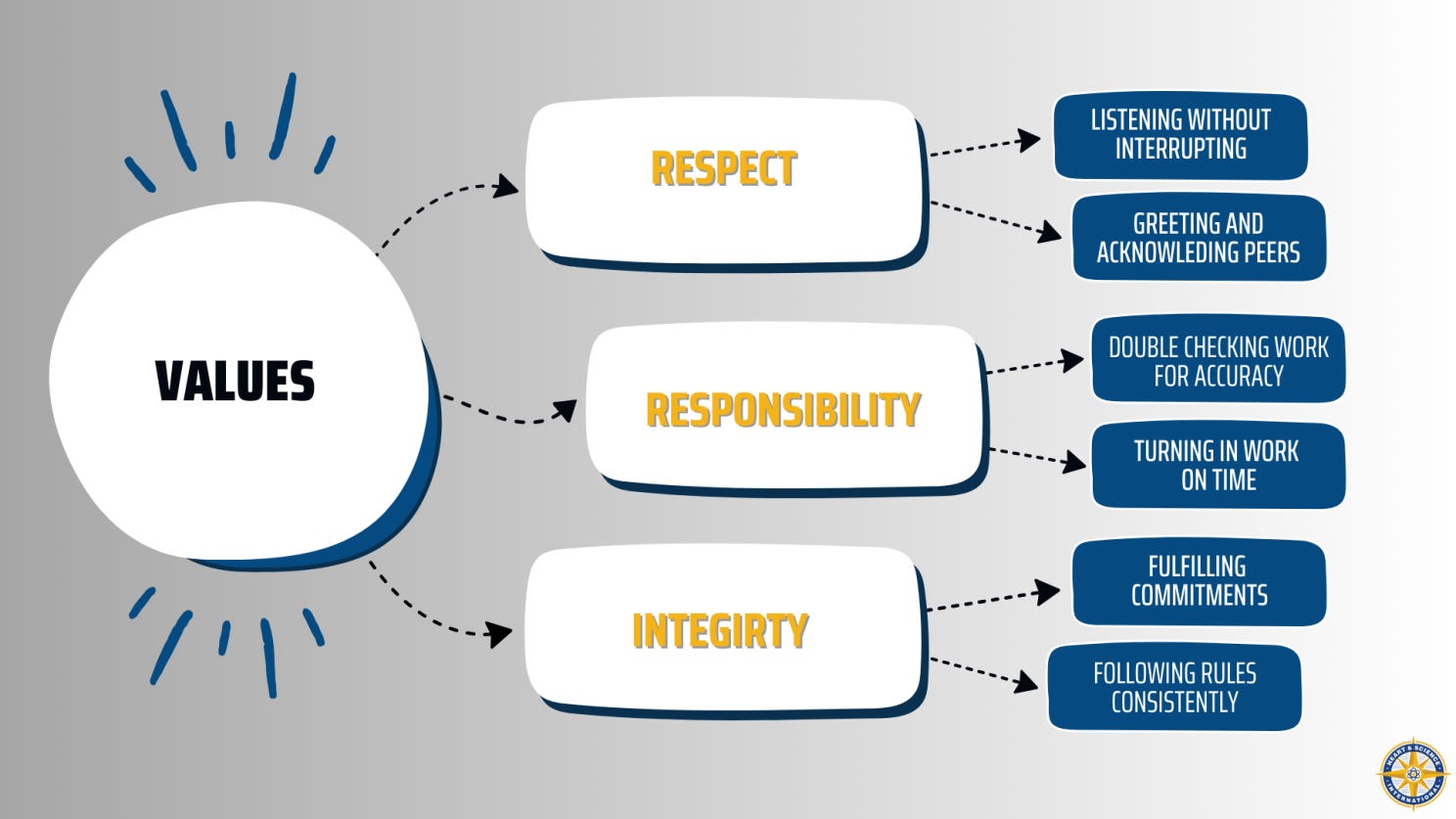
Consider the value of respect, a word that appears in nearly every school mission statement.
The question leaders must ask is simple but often overlooked: What does respect actually look like here?
In one classroom, respect may look like students waiting their turn to speak. In another, it may look like active participation and open discussion. In some cultures, respect is expressed through quiet compliance. In others, it is shown through engagement, eye contact, and thoughtful disagreement.
None of these expressions are inherently right or wrong. They are contextual. Problems arise when values are left undefined and everyone is left to interpret them individually.
Values guide behavior when leaders take the time to clarify how those values are expressed in their specific context. Once defined, those behaviors can be reinforced consistently, creating predictability and alignment across the system.
A useful way to think about this is to treat each value as a bucket. Every behavior aligned with that value adds a drop. Over time, patterns emerge, norms stabilize, and culture becomes visible.
Classroom Example (Teachers)
For a teacher (classroom leader) who values respect and student voice, respect does not mean silence. It shows up when students listen to one another, take turns speaking, and express disagreement without escalating. When a student disagrees respectfully during a class discussion and supports their position thoughtfully, that behavior fills the respect bucket. When the teacher acknowledges that moment—by naming what went well or allowing the discussion to continue—it signals to the class that respectful disagreement is not only allowed, but valued. Over time, students begin to model that behavior with one another because it reliably produces positive outcomes: being heard, taken seriously, and included in the conversation.
School Leader Example (Administrators)
For a school leader who values respect and collaboration, the behavior looks different but serves the same function. Respect shows up when teachers are invited into decision-making, when concerns are listened to without defensiveness, and when professional disagreement is handled openly and constructively. When a teacher raises a concern during a staff meeting and the leader responds by listening carefully, asking clarifying questions, and following up with action, that behavior fills the respect bucket at the leadership level. When that response is consistent, it reinforces staff participation and models how respectful dialogue is handled in the organization. Over time, teachers become more willing to speak up, collaborate, and problem-solve because their behavior produces outcomes they value—being heard, trusted, and taken seriously.
District-Level Example (Central Office / Superintendents)
For a district leadership team that values respect and shared responsibility, respect shows up in how decisions are made and communicated across schools. It is visible when district leaders seek input from principals and teachers before rolling out initiatives, explain the reasoning behind decisions, and remain open to feedback once implementation begins. When a principal raises a concern about an initiative’s impact on instructional time and the district responds by adjusting timelines or providing additional support, that behavior fills the respect bucket at the district level. When this pattern is consistent, it reinforces thoughtful feedback and shared ownership across the system. Over time, school leaders engage more proactively because their input produces outcomes they value—clarity, trust, and a sense of partnership rather than compliance.
Alignment Begins with the Leader
Before leaders can expect alignment from others, they must model it themselves.
This begins with clarity around personal behavior. The Behavior Alignment Map provides a practical structure for doing exactly that by connecting values to daily action and measurable outcomes.
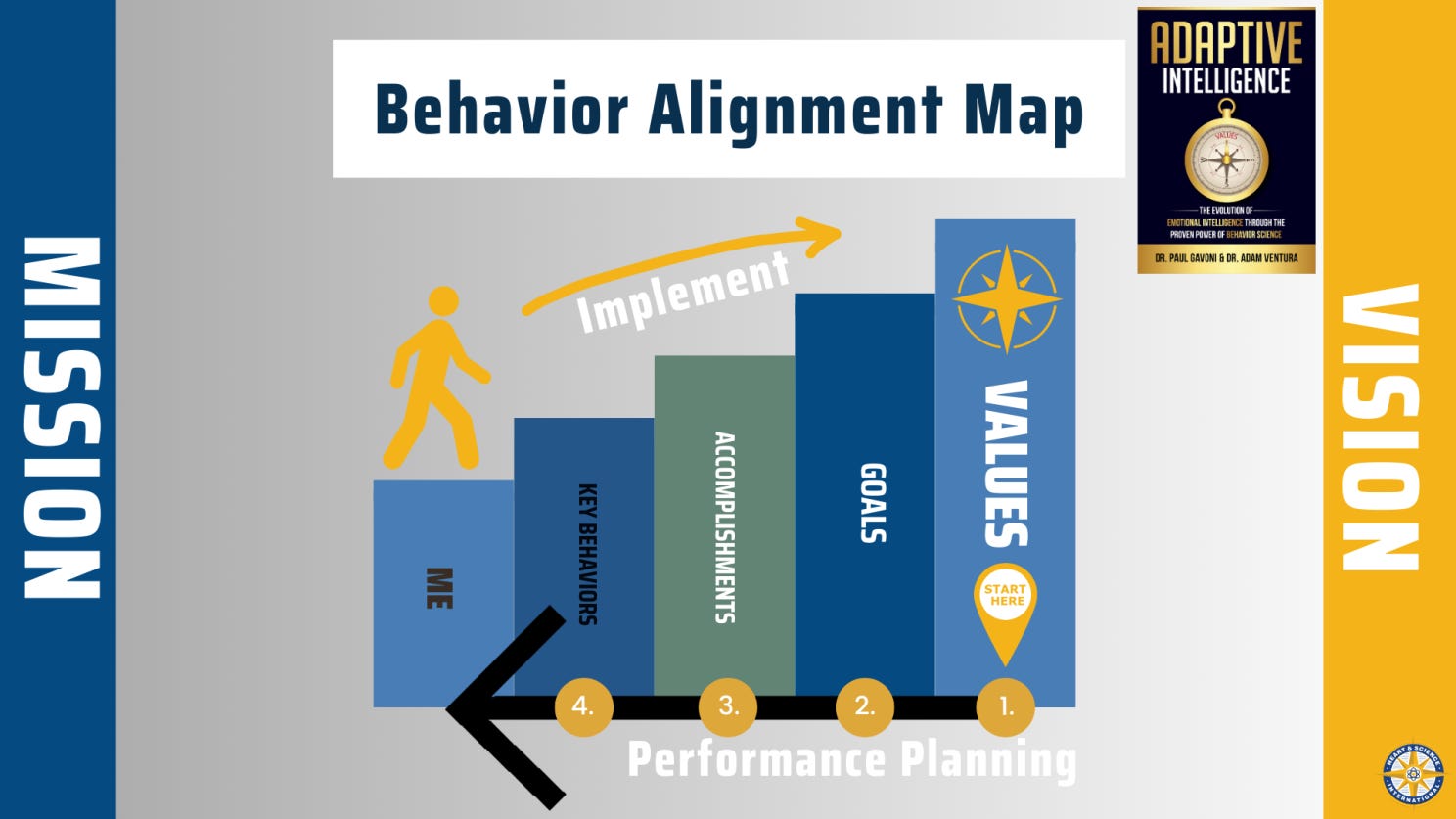
Leaders start by clarifying their vision—the future they are working to create. From there, they define their mission as the behaviors they engage in consistently to move toward that vision. Goals provide direction and checkpoints, while accomplishments offer observable evidence that the work is producing results.
For example, a leader may hold a vision of a school where educators feel supported and effective. Their mission might include regular coaching, clear feedback, and daily reinforcement of effective practice. Goals could focus on improved retention or staff satisfaction, while accomplishments are reflected in climate data, exit interviews, and retention rates.
Alignment shows up in behavior first. When leaders consistently act in ways that reflect their stated values, credibility follows.
Scaling Alignment Across Teams and Systems
Once alignment is established at the individual level, the same principles apply across teams, schools, and districts.
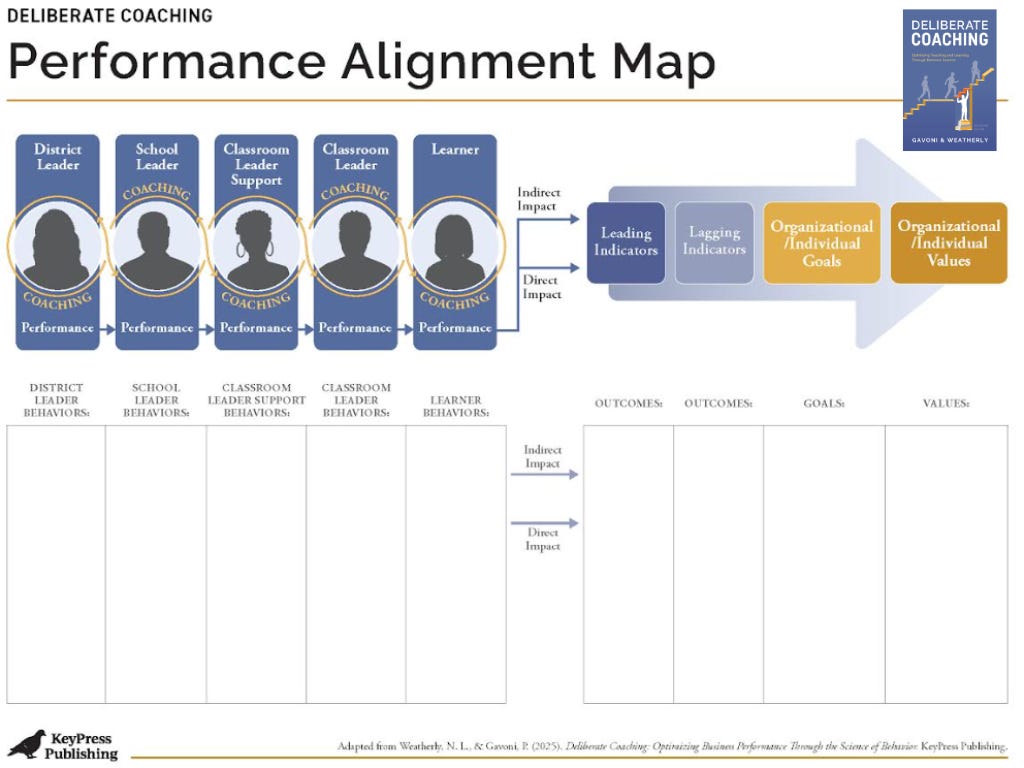
Shared values function when people understand how those values show up in practice, which behaviors represent them, and how the system reinforces those behaviors. When that clarity exists, behavior becomes mutually reinforcing across roles. Student behavior supports teacher behavior. Teacher behavior supports leadership action. The system begins to sustain itself.
When that clarity is missing, people default to personal interpretation. Over time, systems drift, expectations become inconsistent, and frustration increases—not because people do not care, but because alignment was never made explicit.
Leadership at scale is about creating shared understanding and shared reinforcement, not about issuing directives.
Engagement as an Outcome of Alignment
Engagement is often treated as something leaders must generate or inspire. In practice, engagement is a behavioral outcome.
People engage when their behavior produces outcomes they care about. When educators can see how their daily actions connect to meaningful results, effort becomes easier to sustain. That connection does not happen by chance. It is built through leadership that defines values clearly, translates them into behavior, and reinforces them consistently.
Titles do not create engagement. Systems do.
Many of the most effective leaders in schools operate without formal authority. Classrooms function as small organizations, with teachers acting as CEOs who align behavior, environment, and outcomes every day. Their leadership shows up through intentional action rather than position.
Leadership as a Set of Behaviors
From a behavioral perspective, leadership is not a role someone occupies. It is a set of behaviors selected based on context.
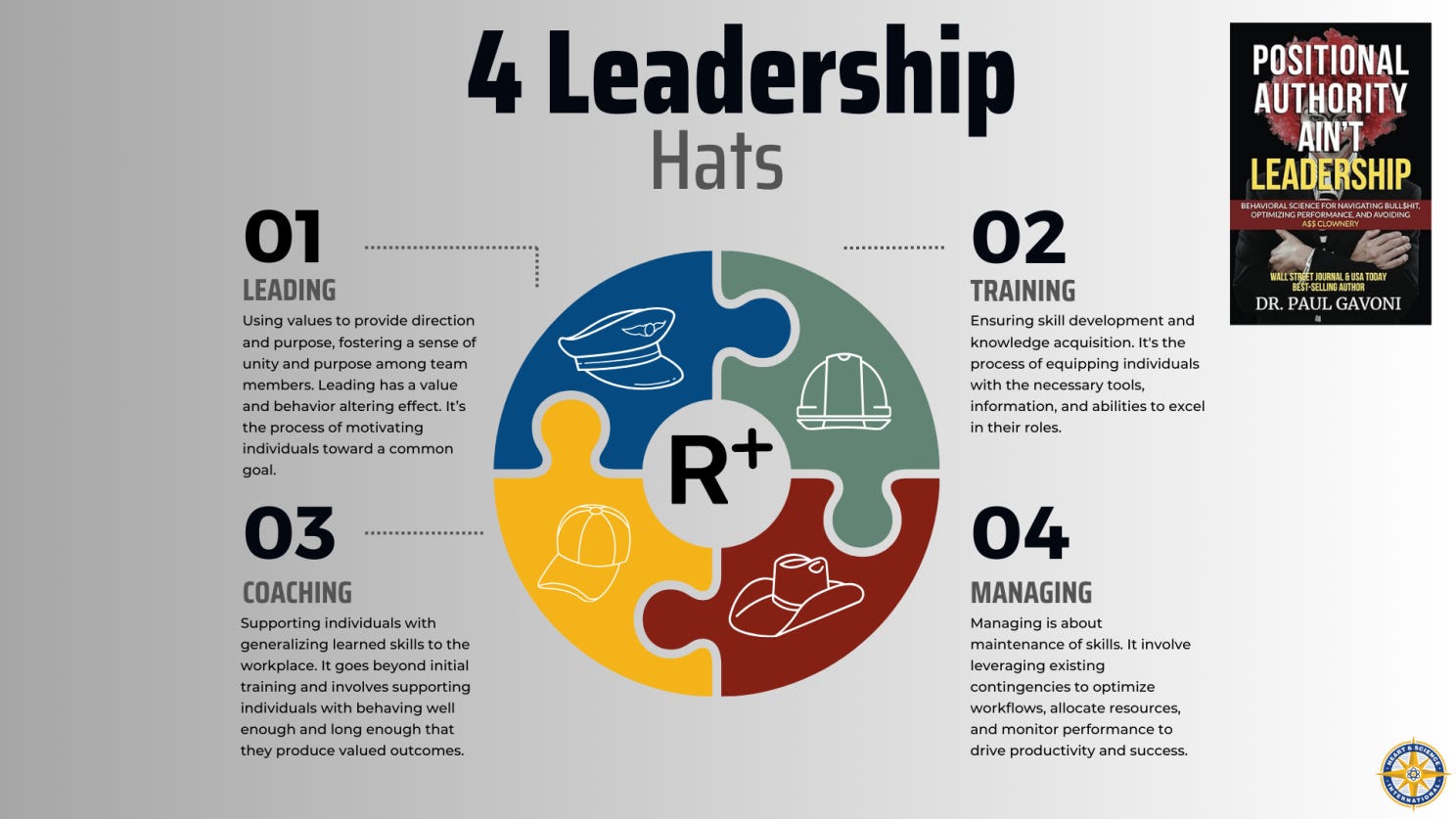
Effective leaders shift fluidly between these four leadership functions. The real challenge is not knowing that different hats exist—it is knowing which hat to wear, when to wear it, and at what level of the system. Making that decision reliably requires more than intuition or experience. It requires a way to understand how behavior is currently shaped across the organization and how it should be shaped to produce the results leaders value.
That is where Organizational Behavior Management becomes essential.
Why OBM Fits Education
OBM fits in education because schools are complex human systems. They are not driven by isolated individuals or single interventions. They are shaped by environments—by expectations, feedback, reinforcement, resources, and leadership behavior interacting across roles and levels every day.
OBM provides leaders with a disciplined way to move from values to action by establishing a clear standard for performance and then analyzing how well current systems support that standard. The Performance Alignment Map allows leaders to describe what an optimal environment would look like if values, behavior, and outcomes were fully aligned. It begins with value-driven end results and works backward, identifying the behaviors and conditions required at each level of the organization.
Once that standard is defined, Behavior Systems Analysis is used to examine the environment that actually exists. This analysis focuses on how behavior is currently influenced across the system—what is being reinforced, what is being ignored, and what barriers prevent people from performing as intended. Rather than asking why individuals are not trying harder, OBM asks a more useful question: What is the system currently designed to produce?
The comparison between the optimal environment and the current one reveals the true performance gap. That gap is not a failure of people. It is information about system design. Understanding the root cause of that gap allows leaders to intervene precisely, rather than reactively.
When values are unclear, the Leading Hat becomes the priority. When skill gaps exist, Training is required. When skills are present but inconsistently applied, Coaching is the appropriate response. When behavior is strong but not sustained, Managing and system-level reinforcement are needed. The intervention is dictated by diagnosis, not by title or habit.
This is why OBM works so well in schools. It gives leaders a way to decide how to lead based on evidence rather than assumption, and to align leadership behavior at every level of the organization with the outcomes they value most.Closing Perspective
Values matter when they guide behavior. Behavior lasts when it is reinforced.
Leadership grounded in behavior science bridges the gap between intention and impact by aligning what people care about with what they do every day. When that alignment is present, systems function more smoothly, engagement increases, and meaningful outcomes become sustainable.
That is not theoretical leadership. It is practical, observable, and effective leadership—done behaviorally.
A Values-Based Call to Action
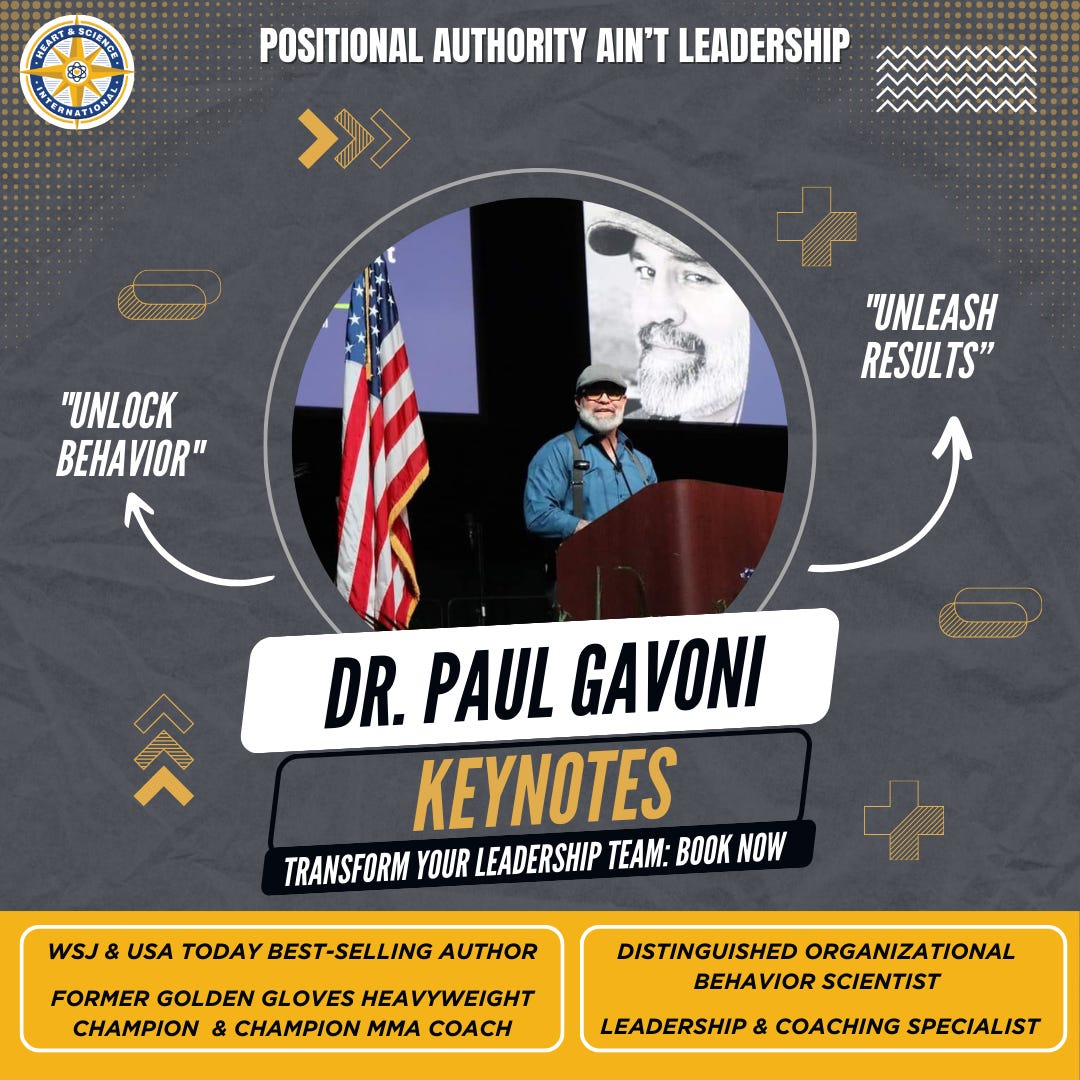
I value helping people. Over time, I’ve learned that the most effective way to do that at scale is by supporting the leaders and systems that shape daily environments.
That realization is what led me back to school. I pursued a specialized degree in educational leadership, completed a doctorate in organizational leadership, and earned a doctoral-level certification in applied behavior analysis—not to collect credentials, but to better understand how leadership, systems, and human behavior actually interact in real settings. For more than a decade, my focus has been on Organizational Behavior Management and how it can be applied practically in schools and other human service organizations.
Leadership is demanding work. Leaders are expected to balance values, people, performance, and systems—often simultaneously and under real constraints. My professional mission is to equip leaders with behavior-science tools that make that work clearer, more effective, and more sustainable.
At Heart & Science International, we do this by engineering values-aligned environments that produce results. The focus is not on fixing people or pointing out what’s wrong. It’s about strengthening systems so that effective leadership is easier to practice and value-added behavior is easier to sustain.
If you’re exploring a keynote or consulting partnership grounded in behavior science and designed for real-world leadership challenges, I’d be glad to talk.
If you’re not ready for that step, a performance-based book study is often a strong place to begin. These experiences help teams apply the concepts directly to their own environment and build shared understanding around what effective leadership looks like in practice. You can learn more by watching the video linked below.
Regarding the topic of the article, I'm truly fascinated by the idea of 'designing systems where what we say we value is reflected in what people actually do', and I wonder how your OBM approach helps leaders navigate the inherent complexity of mapping subjective human values onto predictable behavioral outputs in day-to-day practise across diverse school roles.