The Evaluation Illusion
Why Our Evaluation Systems Are Failing Teachers and Students

Listen, I want to say something that may be uncomfortable to school admin, especially for systems that have relied on the same structures for years. I have not found convincing evidence that traditional teacher evaluations improve performance. In fact, from a behavioral standpoint, I would argue they often do far more harm than good.
Recently, I was talking with a well-meaning administrator who described a teacher’s annual performance goal. The intention was positive. The structure was familiar. The timeline, however, was the problem. One year to work one performance goal.
If we step back and look at this through the science of human behavior, the issue becomes clear. Behavior changes through frequent measurement, immediate feedback, and visible progress. Decades of research across organizational performance show that feedback is most effective when it is timely, specific, and delivered close to the behavior it is intended to influence (Daniels & ; Kluger & DeNisi, 1996). When feedback occurs two or three times a year, performance is not being shaped. It is simply being judged.
And when a system is built around delayed judgment instead of ongoing coaching, the unintended consequences begin to show up.
Why Traditional Evaluations Do Harm
Most evaluation systems follow a predictable pattern. An administrator spends one or two hours observing a classroom, completes a rubric with a limited number of scoring options, and schedules a post-observation meeting days or weeks later. The teacher prepares for the visit, the lesson is polished, and everyone puts their best foot forward.
Then the observer leaves.
From a behavioral perspective, this process has very little influence on day-to-day performance. Feedback is delayed, measurement is broad, and the connection to daily practice is weak. Too often, the observation becomes what many teachers privately describe as a dog and pony show rather than a genuine opportunity for growth. Teachers do not like the process, and administrators typically do not care for it either. Over time, the system becomes less about improvement and more about compliance.
The structure creates several predictable effects.
First, progress becomes invisible. When a rubric allows only a small number of performance levels, improvement within a category is not captured. Large-scale studies of teacher evaluation systems have found that most teachers receive similar ratings, with little differentiation and limited sensitivity to growth over time (Weisberg, Sexton, Mulhern, & Keeling, 2009).
Second, feedback becomes evaluative rather than supportive. Infrequent observation raises the stakes and shifts the tone of the interaction. Instead of ongoing coaching conversations focused on improvement, the process feels like judgment.
Third, the timeline is simply too long. Behavior does not change on annual cycles. If a teacher struggles with transitions in September, waiting until January to revisit the issue is not a performance strategy. It is a delay.
Most importantly, the system focuses on outcomes without managing the behaviors that produce those outcomes. From a behavioral standpoint, this is the equivalent of hoping for change without arranging the conditions that make change likely.
There’s Another Problem: Time

There is another issue with traditional evaluation systems that deserves just as much attention, particularly for school leaders.
Even if the process were producing strong performance gains, the time investment alone would raise serious questions about efficiency and return. In reality, the traditional evaluation structure requires a substantial amount of administrator time while producing relatively little impact on day-to-day instructional practice.
Consider the practical demands. A principal responsible for 30 teachers is typically required to complete at least two formal evaluation cycles each year. Each cycle often includes a pre-conference, a full classroom observation, detailed scripting and scoring, and a post-conference. When those components are combined, a single cycle can easily require three and a half to four hours. Across two cycles, that amounts to roughly seven to eight hours per teacher each year.
For a principal with 30 teachers, the annual time investment ranges between 210 and 240 hours. That is the equivalent of five to six full workweeks devoted almost entirely to formal evaluation activities. This estimate does not include walkthrough documentation, district compliance requirements, calibration meetings, or the additional time required to manage improvement plans.
The more important question is not how much time the process takes. The more important question is what that time produces.
Literature and research across performance management consistently shows that behavior changes when feedback is frequent, specific, and delivered close to the behavior it is intended to influence (e.g., Seiman., et al. 2020; Kluger & DeNisi, 1996). When feedback occurs only a few times per year, the behavioral impact is limited. Leaders are investing weeks of time into a system that does little to influence daily teaching practice.
At the same time, administrators consistently report that they do not have enough time to engage in instructional leadership. They want to be in classrooms more often. They want to provide real-time support. They want to focus on teaching and learning. Yet the structure of the evaluation process pulls large blocks of their time away from the very activities that shape instruction the most.
This time investment becomes even harder to justify when viewed alongside current teacher turnover trends. In many schools, a significant portion of staff changes within a few years, meaning administrators repeatedly invest hundreds of hours into evaluation cycles that must be rebuilt again and again, often with little lasting improvement carried forward.
Evaluating may satisfy compliance requirements. Shaping performance is what improves teaching. A system that consumes weeks of leadership time but does not create the conditions for behavior change is not just inefficient. It pulls leaders away from the work that matters most.
What teachers need is not more evaluation. They need deliberate coaching.
From Evaluation to Deliberate Coaching

Deliberate Coaching® (Gavoni & Weathery, 2025) is built on a simple idea. The goal is to help teachers behave well enough, long enough, for those behaviors to produce outcomes they value. When those outcomes matter to them, the behavior begins to maintain itself.
Research in education and training has consistently shown that feedback combined with coaching produces dramatically higher levels of implementation than training or evaluation alone. In their landmark work on professional development, Joyce and Showers (2002) found that while training alone results in minimal transfer to practice (i.e., only up to 20% with good training), the addition of coaching increases implementation rates to as high as 95% percent.
Instead of managing performance a few times a year, deliberate coaching creates short feedback cycles, clear performance targets, and visible progress. A practical way for schools to think about this is through a three-tier coaching model.
There is a practical methodology for doing this work well. The approach outlined here reflects a system described in my work and one I have trained thousands of school leaders to implement over the years. That system is built around performance diagnostics, performance alignment mapping, and the use of performance logic grounded in basic behavior science.
Because the issue in most schools is not that people do not know what they should be doing. In my experience, the real challenge is getting people to actually do it, consistently and well enough for it to produce results. This is where schools and entire districts tend to fall short. They focus on expectations, training, and evaluation, but they do not build systems that reliably produce the behavior those expectations require.
A full implementation requires structure, leadership skill, and ongoing support. However, the core framework is straightforward and provides a practical starting point for shifting from evaluation to performance improvement.
At a high level, schools can begin organizing this work using a three-tier coaching model.
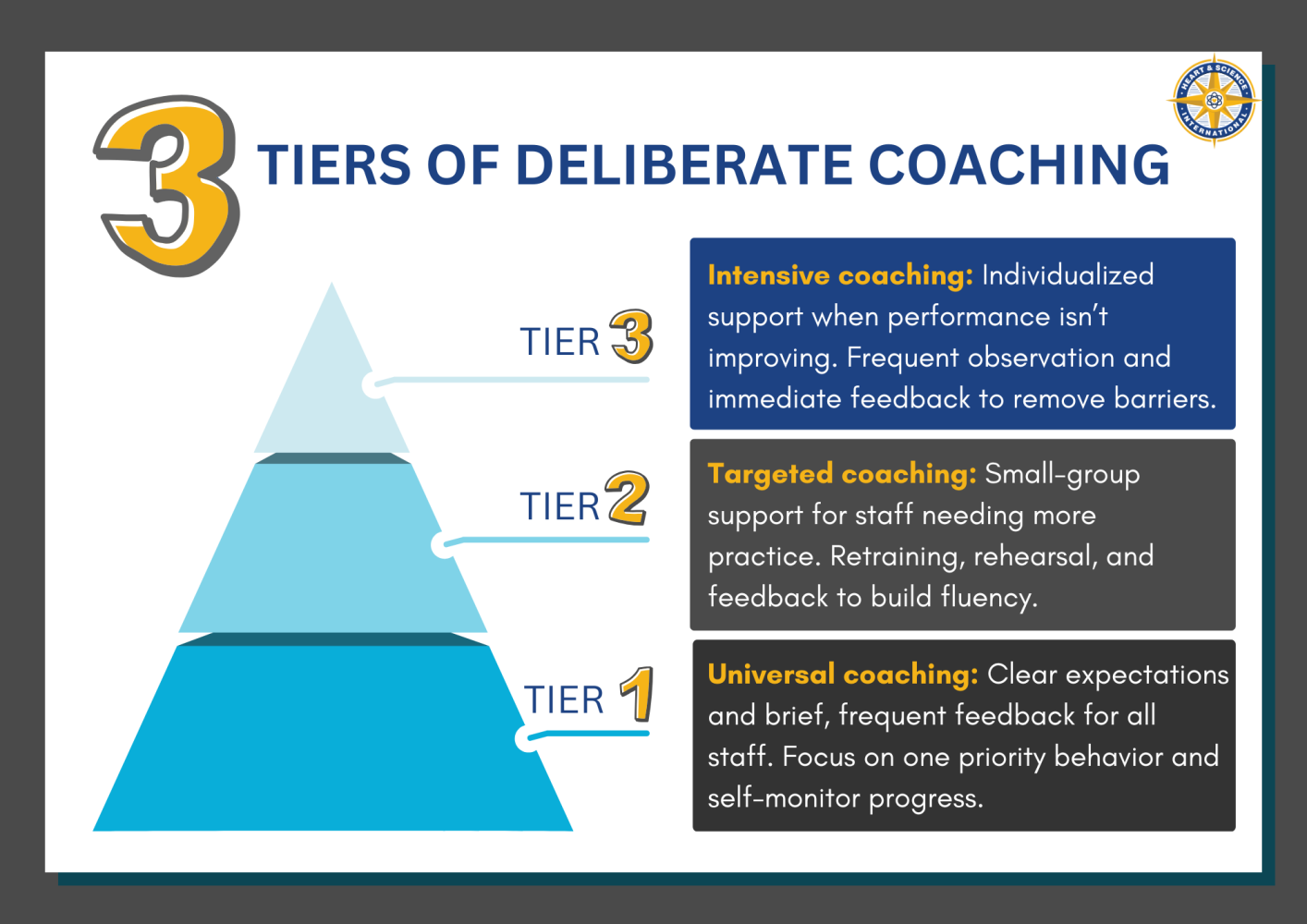
Tier 1: Shared Goals and Self-Management
The foundation of effective coaching begins with ownership. Each teacher should collaborate with their administrator to identify one meaningful performance goal. The goal should be behaviorally specific and connected to student outcomes.
Once the goal is selected, it should be posted publicly in the classroom. This serves two purposes. It reminds the teacher what they are working toward, and it reminds the administrator what to look for when they visit. The focus becomes clear for both people.
Teachers then self-monitor and report their progress. Self-monitoring is one of the most powerful tools for behavior change because it increases awareness and creates immediate feedback. Instead of waiting months to hear how they are doing, teachers see their own progress week by week.
This shifts the system from external evaluation to internal performance management.
Tier 2: Targeted Group Support
One of the advantages of having administrators help select or align goals is efficiency. When several teachers are working on the same performance area, leaders can provide group-level support.
If multiple teachers are working on increasing opportunities to respond, for example, a brief retraining session, modeling demonstration, or simulation can be provided. This allows leaders to address common needs without having to coach each teacher individually.
Group coaching also normalizes growth. Instead of feeling singled out, teachers see improvement as part of a shared professional process.
Tier 3: Intensive Individual Coaching
Some situations require more direct support. Tier 3 coaching is reserved for teachers who need individualized assistance beyond general guidance or group training.
This may include in-class modeling, side-by-side coaching, or structured feedback following brief observations. The key difference from traditional evaluation is the frequency and focus. Instead of long, high-stakes visits, the administrator conducts short, targeted walkthroughs focused on one or two specific behaviors.
The goal is not to rate the lesson. The goal is to shape the behavior.
Short Visits, Clear Focus, Real Impact

One of the biggest shifts in a deliberate coaching model is moving away from long observation sessions. Spending an hour or two in a classroom and then discussing performance later does little to influence daily behavior.
Performance improves when feedback is frequent, specific, immediate, and focused. Meta-analytic research across industries has shown that performance feedback is one of the most reliable interventions for improving workplace behavior when delivered consistently and tied to observable actions (e.g., Alver et al., 2001).
Short, regular walkthroughs aligned to the teacher’s goal create far more impact than occasional extended observations. When administrators enter the classroom, they are not conducting a full evaluation. They are checking for interobserver agreement with the teacher’s self-monitoring and providing quick feedback tied to the target behavior.
This creates alignment, reduces anxiety, and keeps the focus on growth.
It also saves time. A three- to five-minute visit focused on one priority behavior allows leaders to see more classrooms in a single day than traditional observation models ever allow. Instead of blocking hours for a single evaluation, administrators can provide meaningful feedback across multiple teachers in the same amount of time. In the short run, this shifts leadership time away from paperwork, scripting, and compliance and back into classrooms where it actually influences instruction.
The long-term time savings are even greater. When performance improves through frequent coaching, fewer teachers require intensive support, fewer formal remediation plans are needed, and leaders spend less time managing performance problems later. Instead of repeating lengthy evaluation cycles each year with limited change, administrators invest small amounts of time consistently and build stronger performance that sustains itself. The result is a system that requires less time to manage because it produces better performance by design.
Creating a Practical Rhythm for Schools
Administrators often ask what kind of structure makes this sustainable. A practical rhythm is to establish one or two performance goals per month, with progress reviewed regularly. At most, goals should run on a quarterly cycle. This timeline is short enough to maintain momentum and long enough to produce meaningful change.
Goals should be sequenced around pivotal practices that have the greatest impact on classroom outcomes. For new teachers, early priorities might include classroom management and increasing opportunities to respond to increase engagement and on-task behavior. As those behaviors stabilize, the focus can shift to instructional precision, feedback quality, or other engagement strategies.
When a goal is achieved, it should be celebrated, and the teacher should move on to the next area of growth. This reinforces improvement and keeps the process forward-moving.
Why This Approach Works
From a behavioral standpoint, deliberate coaching works because it aligns with how performance actually changes. It shortens the feedback loop. It makes progress visible. It reinforces improvement along the way. It builds self-efficacy through mastery experiences. It focuses on behaviors that produce valued outcomes.
Over time, teachers begin to experience the natural reinforcement of their improved practice. Student engagement increases. Instruction runs more smoothly. Stress decreases. When those outcomes matter to the teacher, the behavior sustains without heavy oversight.
That is the point where coaching turns into professional growth rather than compliance.
Rethinking the Purpose of Evaluation
Schools do need accountability. Systems do need structure. Administrators do need a rhythm for supporting staff. The question is not whether performance should be monitored. The question is whether the system is designed to judge performance or to improve it. Traditional evaluations check the box. They satisfy policy requirements. They produce ratings.Deliberate coaching changes behavior.
If the goal is better teaching and better outcomes for students, our systems should reflect the science of how people actually improve. Performance does not change because we observe it a few times a year. Performance changes when we shape it, reinforce it, and support it where it actually lives—in the daily work of the classroom.
If this perspective resonates, there is a practical path forward. The approach outlined here reflects the work we do with school and district leaders across the country to shift from evaluation systems to performance systems grounded in the science of human behavior.
Need Inspiration or Training?

If you’re looking to inspire your team and move from ideas to real behavioral and performance change, my Behavioral Leadership Keynotes are designed to create that momentum. Because all results in education require behavior. When results aren’t where you want them, it means people need to do something more, less, or differently.
There’s something for every audience. Leadership isn’t about a title. It’s about influence, alignment, and understanding the science of human behavior that drives performance at every level. My keynotes and training are built around the practical frameworks from my books and are designed to help educators, leaders, and organizations turn inspiration into action.
To explore keynote options, training opportunities, or customized support, visit heartscienceinternational.org or email thedeliberatecoach@gmail.com to request a menu of available keynotes and training.
References
Alvero, A. M., Bucklin, B. R., & Austin, J. (2001).An objective review of the effectiveness and essential characteristics of performance feedback in organizational settings (1985–1998). Journal of Organizational Behavior Management, 21(1), 3–29.https://doi.org/10.1300/J075v21n01_02
Daniels, A. C., & Daniels, J. E. (2014). Performance management: Changing behavior that drives organizational effectiveness. Performance Management Publications.
Gavoni, P., & Weatherly, N., (2024). Deliberate coaching: Optimizing teaching and learning through behavior science: Education edition Keypress Publishing.
Joyce, B., & Showers, B. (2002). Student achievement through staff development. Assn for Supervision & Curriculum
Kluger, A. N., & DeNisi, A. (1996). The effects of feedback interventions on performance: A meta-analysis. Psychological Bulletin, 119(2), 254–284.
Sleiman, A. A., Sigurjonsdottir, S., Elnes, A., Gage, N. A., & Gravina, N. E. (2020).A quantitative review of performance feedback in organizational settings (1998–2018).Journal of Organizational Behavior Management, 40(3–4), 303–332.https://doi.org/10.1080/01608061.2020.1823300
Weisberg, D., Sexton, S., Mulhern, J., & Keeling, D. (2009). The Widget Effect. The New Teacher Project.